
Are you worried about rising energy bills? Do you want a solution that makes your home comfortably warm and equally sustainable, so you can contribute to making the world a better place to live?
One of the great solutions, the most preferable for UK’s cold winters, is external wall insulation. It provides additional benefits of beautifying your home and increasing its worth in the real estate market.
This blog post aims to highlight the benefits of external wall insulation, abbreviated as EWI sometimes. However, we will start from the basics.
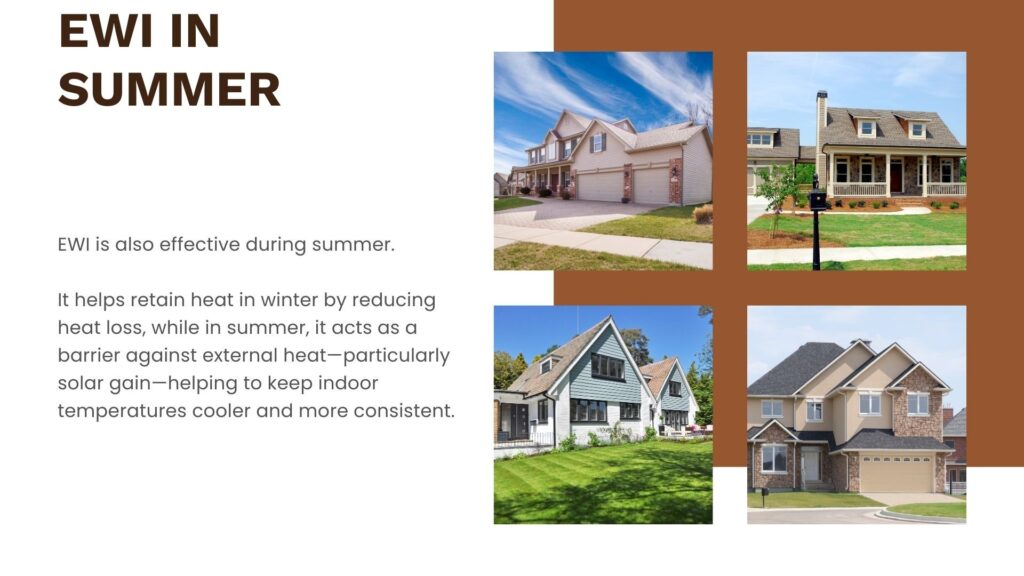
What is External Wall Insulation?
External Wall Insulation is sometimes referred to as Solid Wall Insulation.
It is a great system designed for improving the thermal performance of a building. The mechanism is to attach the insulation boards to the outside of external walls. Imagine wrapping up your home in a warm blanket.
In most cases, these boards are made of mineral wool, phenolic foam, or EPS. Other insulating materials can also be used. Different layers are applied in the process which we will discuss soon. At the end, experts cover all this material with a decorative render finish. External Wall Insulation is mostly used in solid walls.
External wall insulation is the best option if your house has solid walls rather than cavity walls.
Layers That EWI Includes
Several layers are used in the application of EWI. Let’s discuss them one by one:
1: Adhesive Layer
It is the first layer that we directly apply to the walls. Insulation panels are securely bonded.
2: Insulation Board
Insulation Board is the core layer. It is responsible for actual insulation. It ensures the reduction in heat loss. The method it uses is to create a thermal barrier between the interior of the home and the external environment.
3: Reinforcement Layer
It adds strength and durability to the insulation system. The purpose is to prevent cracks and other damage.
4: Fixing anchor and glass mesh
We install these anchors on the insulation board. Their function is to secure the mesh layer.
5: Primer
It helps waterproof the external wall insulation. The other way is to help even out the surface and prepare it for the topcoat.
6: Finishing Render Layer
Its function is both to add aesthetics and provide protection. External wall rendering gives you a great final look for the home, which also helps improve its worth.
Key Benefits of External Wall Insulation
Here are some major advantages of getting your house externally insulated.
Benefit 1: Better Thermal Efficiency & Reduced Bills
One of the main pros of external wall insulation is better thermal efficiency. Your heating bills are reduced, and that reduces your carbon footprint. Your heating system has to put less effort into keeping your home warm.
Good thermal efficiency means that less heat escapes through the roof and walls. Dependence on central heating declines.
Benefit 2: Less Damp & Mould
Since breathable insulation lets the moisture out, it helps reduce the risk of damp and mould on your walls and ceilings. That also helps avoid structural issues with timber and masonry.
Benefit 3: Improved Air Quality
Damp and mould can even increase the risk of residents developing health issues. An NHS report shows that it increases the risk of respiratory problems, worsens existing disorders, and can even affect the immune system. Good insulation minimises these risks by giving you and your family healthier air to breathe in.
Benefit 4: Saves Internal Floor Space
That makes it a better option compared to internal wall insulation. Internal wall insulation involves attaching the insulating material to the interior walls. That primarily reduces your floor space. External wall insulation saves your floor space.
Benefit 5: Less Cold Bridging
Sometimes, there are areas in the house where there is a gap in the insulation. These are the cold spots susceptible to condensation and mould when warm, moist air in the property passes through them. Such an area is called a cold bridge.
One of the benefits of external wall insulation is that it minimises cold bridging. You get continuous insulation over any weaknesses in the walls.
Benefit 6: Protection for Building’s Structure
External wall insulation protects your home from harsh weather or provides great weatherproofing in other words. It prevents condensation, damp, or mould. All these factors can even damage the structure of the building. The repairs can be expensive. So external wall insulation also protects your house from damage.
Benefit 7: Minimal Interruption
You do not have to make big changes in your schedule.
In many cases, any sort of significant home improvement can disturb your family’s daily routine. Sometimes, you even have to move out for a couple of days. You may need a lot of preparation before house repair work can even begin.
In the case of internal wall insulation, the list is long. You need to move radiators, plug sockets, or other fixings in all the rooms that you want to install the insulation in, and then redecorate the walls.
External wall insulation, on the other hand, comes with minimal interruption.
Benefit 8: Improves the Appearance of Your Home
External wall insulation and especially the render applied in its end make the home look stylish and elegant. You can find different types of renders for your house in many different vibrant designs. When you cover the walls with insulation and a new render finish, you refresh your home’s look.
Benefit 9: Increases The Value of Property
Of course, the house with a great look and thermal efficiency becomes more desirable. This increases the price of houses in the real estate market.
Benefit 10: Sound Proofing
Adding layers can help reduce outside noise. That is particularly beneficial for homes in busy urban areas or near noisy roads.
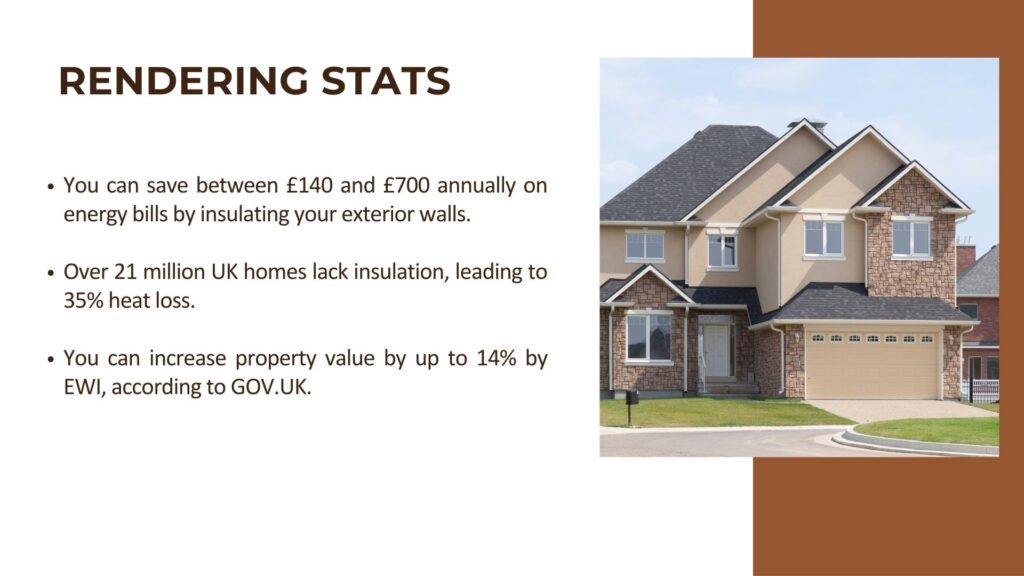
Enhances Durability and Protection of the Building
Durability is one of the greatest benefits of rendering. Render serves as a powerful shield from damage, cracks, and weather. Otherwise, all these complaints are common after some time of application. You get an insulation with a longer lifespan.
Render Improves Thermal Performance
The thermal performance of EWI also improves after render. It is an extra layer over the insulation that minimises thermal bridging. The building becomes more energy-efficient, as warmth stays inside during winter. A more consistent indoor temperature gives you lower energy bills.
Render Enhances Aesthetics and Property Value
Rendering makes the house look beautiful, gives it a unique style, and increases its worth in the market. There are different types of rendering like Silicone Rendering, Monocouche Rendering, Lime Rendering, etc. They come in different finishes and colours and help homeowners upgrade the curb appeal of their property. Acrylic Rendering in UK is one of the most famous rendering types.
Render Prevents Moisture and Improves Weather Resistance
In the UK’s often damp climate, it serves as an essential moisture barrier. You can prevent water ingress, which is a common issue in uninsulated walls. Rendering keeps the structure safe from potential damp and mould problems.
Conclusion
So external wall insulation is a great idea, since there are numerous benefits of external wall insulation. It improves energy efficiency by reducing heat loss, gives you lower energy bills, and reduces the carbon footprint of your house. You get a comfortable and stylish home to live in with great market value.
