
This middle-class Thornton Heath family living in a semi-detached home couldn’t believe what they read on their energy bills this January. Last year’s memory of keeping the thermostat at 19 and still shivering with cold was still fresh in their minds. Yet this season they kept the thermostat lower, but still the energy bill reads the number £800 lower than the previous year.
It is not just a sweet twist of fate, but the real wonder of external wall insulation which many people refer to as EWI (External Wall Insulation). Croydon homeowners across the borough are quietly transforming how their homes perform. Without spending an extortionate amount, they now keep their homes comfortably warm with EWI Croydon.
What Makes Croydon Homes Lose Their Heat?
The simple answer is solid walls. Victorian terraces in Purley, Thornton Heath, and South Croydon were built before 1920. The concept of cavity walls and insulated walls had not been introduced yet. Surveys confirm that almost 35% of heat loss occurs due to uninsulated walls.
External wall insulation stops this heat loss. It wraps a thermal barrier around the house.
In this guide, you’ll see exactly how EWI works, and what it costs in Croydon today. The reading goal is to help you take the first step toward a warmer, cheaper home, no matter if you live in a terraced house in Norbury or a semi in Coulsdon. It is now easier to reduce heating bills in Croydon, and we are here to help you.
Why Your Croydon Home is Leaking Heat & Money Every Single Day
We know that uninsulated walls are responsible for 35% of heat loss. Now, the typical annual energy bill in Croydon is £1,400. Now calculate and you will know that by insulating you can reduce it to 35% and cut almost £490 per year from it. Yes, £490 is what just your uninsulated walls cost you, not any draughty windows, or the loft.
Almost 20% of Croydon homes were built before 1920. This includes the Victorian terraces concentrated in Thornton Heath, South Croydon, and Purley. Having no cavity makes their thermal performance low.
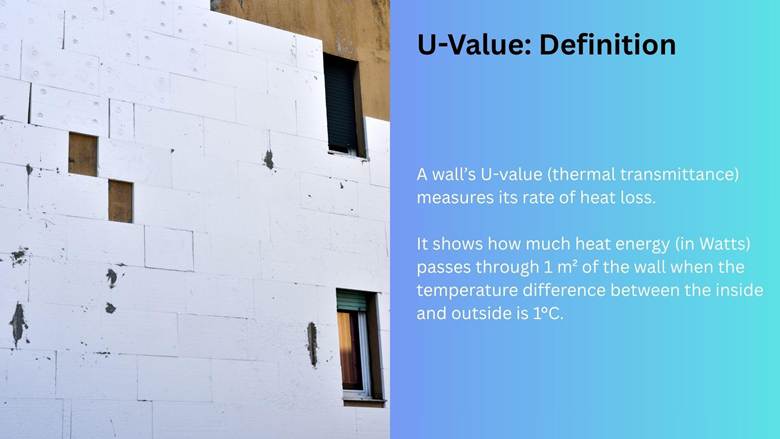
A solid brick wall has a U-value (a measure of heat flow) of around 2.1 W/m²K. Modern building regulations ask for 0.30 W/m²K or better. And what costs you money? It is the gap between where your walls are and where they need to be.
| Property Type | Estimated Heat Lost Through Walls | Est. Annual Cost of That Loss |
| Mid-terrace (3-bed) | 25–30% | £350–£420 |
| End-of-terrace (3-bed) | 30–38% | £420–£530 |
| Semi-detached (3-bed) | 28–35% | £390–£490 |
| Detached (4-bed) | 32–40% | £450–£560 |
Based on Energy Saving Trust data and average Croydon household heating spend of £1,400/year.
What Is External Wall Insulation – And How Does It Stop the Heat Loss for Good?
Think of EWI as a blanket wrapped around your house. It does not let the heat go out and keeps your home warm. Or maybe it can be referred to as a coat that you never take off.
Since it is external wall insulation, you do not have to reduce your room sizes or experience any kind of internal disruption. The process adds thermal mass to the outside of your walls, prevents cold bridging at junctions, and delivers a fresh exterior finish at the same time.
Here is the EWI installation process goes:
- Experts fix the insulation boards to your external walls: They use a combination of specialist adhesive and mechanical fixings. You get a thermal layer without any gaps or cold bridges around your house.
- Reinforcing mesh and basecoat are applied: Experts apply both to the insulation boards. The mesh is embedded into wet render to create a rigid, weather-resistant substrate.
- Now comes primer and decorative render finish: In most cases, it is silicone, acrylic, or monocouche render. They are provided in the colour and texture that you choose.
- Teams install new roof trims, window sill extension and door surrounds: This completes the weathertight envelope around your property.
Researchers say that a correctly installed EWI Croydon system can bring the U-value of your Croydon home to .27 W/m²K.
The Real Numbers: How Much Are Croydon Homeowners Actually Saving?
| Property Type | Typical Annual Bill (Before) | Typical Annual Bill (After) | Annual Saving |
| Semi-detached (3-bed) | £1,600 | £950 | £650 |
| End-of-terrace (3-bed) | £1,950 | £1,150 | £800 |
| Detached (4-bed) | £2,300 | £1,350 | £950 |
Figures based on Energy Saving Trust modelling and installed project data. Actual savings vary by property size, heating system, and occupancy.
Average UK energy bills remain roughly 40% above pre-2021 levels and make EWI payback period shorter than ever. You benefit from the lower bills since the first winter, though £12,000 installation saving £800 per year takes 15 years to completely pay back. Energy prices going back to 2019 levels is a highly unlikely scenario. Future savings could be even greater than the figures we just mentioned above.
Croydon homeowners should also remember this EPC angle to consider this situation. A majority of pre-1920 solid wall properties sit at the E or F band of EPC. When you apply the external wall insulation, a D-rated home normally comes to B.
An EPC rating is not just a simple environmental credential with no other benefit. Homes with a good EPC rating also attract more buyers. They are easier to sell. In some cases, they make up a necessary prerequisite to mortgage certain products.
If you have a house with a good EPC rating in Croydon, you have a great financial asset to sell in today’s Croydon market.
Want to see what your Croydon property could save? Get your free survey →
How Much Does External Wall Insulation Cost in Croydon?
The cost to get EWI Croydon for a typical Croydon property, is mostly something between £8,000 and £18,000. A 3-bed semi-detached is the most common project, and it falls typically between £10,000 and £14,000.
A 3-bedroom end-of-terrace with three exposed walls, would be at the higher end of that range in most cases. But if it is mid-terrace with only front and rear elevations of homes, the price would come to the lower end of this range.
Three main factors affect where your property sits within that range:
- Property size and number of exposed walls – Labour cost and material cost are directly proportional to the wall area and number of walls. A mid-terrace has two elevations; end-of-terrace or semi has three; a detached property has four.
- Insulation thickness – 80mm EPS boards are standard for most properties; 100mm is recommended if you want to achieve maximum performance goals. It can modestly add to the cost as well.
- Render finish chosen – Silicone render is the premium option (more flexible, longer-lasting, self-cleaning); acrylic is mid-range; monocouche is a through-colour render often used on traditional-style homes.
Grants and Funding Available in Croydon
You can cover 100% of your installation costs with the ECO4 scheme, if you are one of the eligible households. The scheme is currently extended to December 2026. One of the eligibility criteria is a low EPC rating. Another grant available via Croydon Council is Warm Homes Local Grant.
You do not need anything upfront if you utilize one of these schemes. Eligibility is based on household income, property EPC rating, and tenure. A free survey will establish whether your home qualifies.
The Investment Case in Plain Terms
15 years is the typical payback period for £12,000 EWI installation, while its annual savings are £800 without considering any unpredictable rise in energy prices. Any uplift in property value due to EPC improvement is also not taken into account.
Our EWI Installation Process in Croydon: From Survey to Silicone Finish in 5 Steps
Disruption is the most common concern for homeowners considering EWI Croydon. What if we have to move out or what if it disturbs the appeal and look of the house? How long would it take? Honestly, the level of disruption is way less than we sometimes imagine. You do not need to move out.
Step 1 – Free property survey (45–60 minutes)
The team of the company you hire visits Croydon property and assesses wall type, condition, and construction. They may also measure the total wall area, check for any existing damp or structural issues that need to be addressed first, and confirm the right insulation specification for your home. Most providers do not charge for it.
Step 2 – Written specification and fixed-price quote (within 48 hours)
With the help of data collected in the previous step, they offer you detailed written specifications. It explains exactly what will be installed, what standard, and at what price. Professional providers avoid hidden extras, and vague estimates.
Step 3 – Installation (typically 3–7 working days)
The installation process has already been explained at the start. Professionals will follow the sequence of scaffolding, insulation boards installation, mechanical fixings, and specialist adhesive.
Step 4 – Aftercare and guarantee
At the end of the project, you receive a 10-year product and workmanship guarantee that stays with the property. Professional companies will issue you a full certificate that can be used for EPC reassessment and mortgage purposes.
Do not worry about disruption. All work is external. You can peacefully stay in the house throughout the entire installation.
I Wish I’d Done It 10 Years Ago- A Croydon Homeowner’s Honest Verdict on EWI
Lily has been living in Thornton Heath in her end-of-terrace home for years. She was well-aware of her house being too cold, since the living room’s temperature never crossed 17°C in winter mornings, no matter how long she used the energy system.
Assuming all Victorian houses work the same way, she never took it seriously. But when the annual gas bill exceeded £2,000, and a neighbor told her about the benefits of external wall insulation, she thought her bills made this option worth trying.
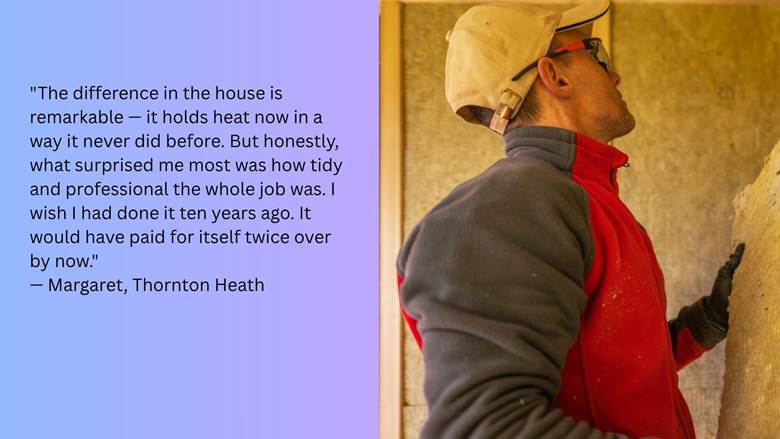
She knew she had made the right choice, the moment the surveyor provided her details such as which walls were losing the most heat, how much his company could help her save on bills, and the U-value her walls would be able to achieve. The installation didn’t take more than a week, and the first winter bill after installation exceeded her expectations. It read £1,190, which meant she was saving almost £810 per year.
If you have before-and-after photos of your own Croydon EWI project, this is exactly the kind of transformation they would show: same house, same brickwork underneath, entirely different thermal performance and street presence.
Frequently Asked Questions
Does external wall insulation work on older homes?
Yes, EWI is in fact the most effective insulation solution for pre-1920 solid wall properties, which make up the majority of older homes in Croydon.
How long does external wall insulation last?
A correctly installed EWI system with a quality render finish – silicone in particular – should last 30 years or more with minimal maintenance.
Ready to Find Out What Your Croydon Home Could Save?
The numbers we mentioned in the guide are real. Their source is installed projects across Croydon’s Victorian housing stock, cross-referenced with Energy Saving Trust modelling. We at Exterior Rendering Systems, can be the right choice for you in Croydon if you are also considering getting EWI in Croydon.
Whether your property is in Thornton Heath, Purley, South Croydon, or anywhere else in the borough, our starting point is the same: a free, no-obligation survey that tells you exactly what EWI could deliver for your specific home.
Book your free EWI survey in Croydon →
No commitment. No sales pressure. Just specific numbers for your specific property.
